
“The correct remedy cures only when administered in the correct potency.”
Potency selection is one of the most challenging and fascinating aspects of homoeopathic prescribing. While remedy selection identifies what medicine to prescribe, potency selection determines how deeply and effectively that medicine acts.In this article, we will discuss the important factors influencing the selection of potency based on classical homoeopathic principles and the comparative table shown above.
What is Potency in Homoeopathy?
Potency refers to the degree of serial dilution and succussion given to a homoeopathic medicine. Although the medicinal substance becomes highly diluted, the process of potentization is believed to enhance its dynamic therapeutic action.
Common potency scales include:
- Decimal (X or D)
- Centesimal (C)
- LM/Q Potencies
For practical prescribing, potencies are generally categorized as:
- High Potency: 1M, 10M, CM and above
- Medium Potency: 30C – 200C
- Low Potency: 3X, 6X, 12X, 30X
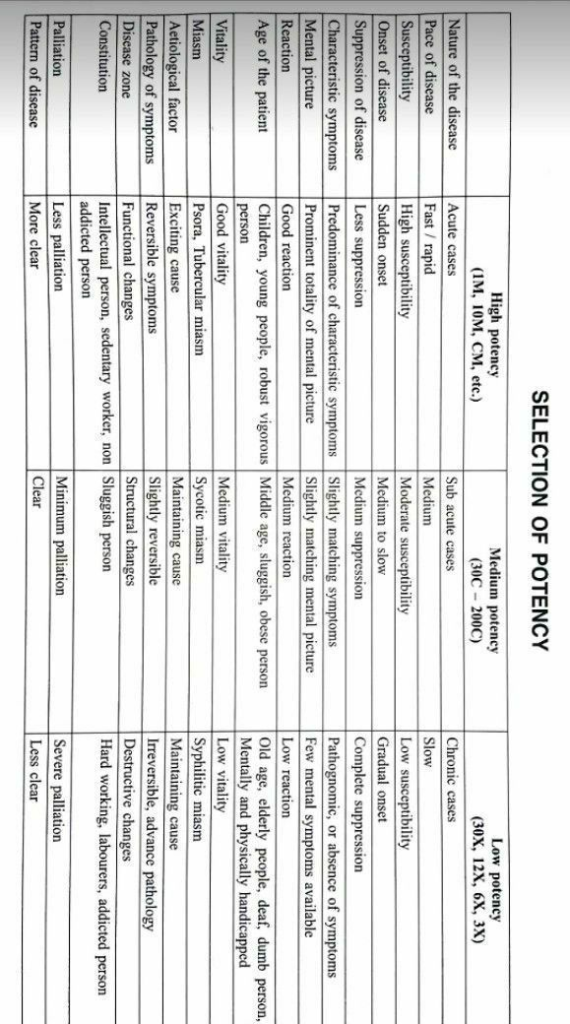
Principles of Potency Selection
Potency selection depends upon multiple patient-related and disease-related factors rather than the disease name alone.
Below are the major considerations.
1. Nature of Disease
High Potency
- Acute diseases
- Functional disturbances
- Rapidly developing conditions
Examples:
- High fever
- Acute allergic reaction
- Sudden emotional shock
Medium Potency
- Subacute diseases
- Intermediate conditions
Low Potency
- Chronic diseases
- Long-standing pathological conditions
- Structural degeneration
2. Pace of Disease
High Potency
- Fast progression
- Rapid symptom evolution
Medium Potency
- Moderate pace
Low Potency
- Slow progression
- Long-standing illness
3. Susceptibility of the Patient
Susceptibility is the patient’s ability to respond to the remedy.
High Potency
Suitable for patients with:
- High susceptibility
- Sensitive nervous system
- Strong reactive power
Medium Potency
Patients with average susceptibility.
Low Potency
Patients with:
- Low vitality
- Poor response
- Advanced pathology
4. Onset of Disease
| Onset | Recommended Potency |
|---|---|
| Sudden | High Potency |
| Moderate | Medium Potency |
| Gradual | Low Potency |
5. Suppression of Disease
Less Suppression
- High potency often acts well.
Moderate Suppression
- Medium potency preferred.
Complete Suppression
- Low potency should be started cautiously.
6. Characteristic Symptoms
Characteristic symptoms guide both remedy and potency.
High Potency
When:
- Peculiar symptoms predominate
- Clear individuality exists
- Complete symptom picture available
Medium Potency
Symptoms only partially characteristic.
Low Potency
When:
- Few symptoms available
- Mainly pathological signs present
- Characteristic symptoms absent
7. Mental Picture
Kent, Boenninghausen and other masters emphasized the importance of mental symptoms.
High Potency
- Strong, clear mental symptoms
- Emotional and intellectual characteristics prominent
Medium Potency
- Partial mental picture
Low Potency
- Mental symptoms absent
- Physical pathology predominates
8. Reaction of the Patient
High Potency
Good reaction
Examples:
- Previous remedies produced quick improvement.
Medium Potency
Moderate reaction
Low Potency
Poor reaction
- Weak response to previous treatment
- Low reactivity
9. Age of the Patient
High Potency
Usually suitable for:
- Children
- Young adults
- Robust individuals
Medium Potency
- Middle-aged individuals
- Obese persons
- Sluggish constitutions
Low Potency
Recommended for:
- Elderly patients
- Physically handicapped individuals
- Frail persons
10. Vitality
Vital force determines the body’s capacity to respond.
High Potency
Strong vitality
Medium Potency
Moderate vitality
Low Potency
Low vitality
11. Miasmatic Background
| Miasm | Preferred Potency |
|---|---|
| Psora, Tubercular | High Potency |
| Sycosis | Medium Potency |
| Syphilis | Low Potency |
Note: Potency should never be selected solely on miasmatic diagnosis. It should always be correlated with the totality of symptoms.
12. Etiological Factor
High Potency
Exciting causes such as:
- Grief
- Fear
- Shock
- Acute exposure
Medium Potency
Maintaining causes
Examples:
- Poor lifestyle
- Diet
- Environmental influences
Low Potency
Chronic maintaining causes with structural disease.
13. Pathology of Symptoms
High Potency
Functional disorders
Examples:
- Neuralgia
- Functional dyspepsia
- Early disease
Medium Potency
Beginning structural changes
Low Potency
Advanced pathology
Examples:
- Fibrosis
- Cirrhosis
- Osteoarthritis
- Organ destruction
14. Constitution
High Potency
Best suited for:
- Intellectual persons
- Sedentary workers
- Highly sensitive individuals
Medium Potency
- Sluggish constitutions
Low Potency
- Hard-working laborers
- Individuals with low sensitivity
- Patients with addictive habits
15. Palliation
High Potency
Least palliation
Acts curatively with a deep and lasting effect.
Medium Potency
Moderate palliation
Low Potency
More likely to produce temporary palliation.
16. Pattern of Disease
High Potency
Disease picture is clear and individualized.
Medium Potency
Moderately clear presentation.
Low Potency
Disease picture is vague or obscured by pathology.
Comparative Summary Table
| Parameter | High Potency (1M, 10M, CM) | Medium Potency (30C–200C) | Low Potency (3X–30X) |
|---|---|---|---|
| Disease | Acute | Subacute | Chronic |
| Pace | Fast | Moderate | Slow |
| Susceptibility | High | Moderate | Low |
| Onset | Sudden | Moderate | Gradual |
| Mental Symptoms | Strong | Partial | Absent |
| Characteristic Symptoms | Well-marked | Moderate | Few |
| Vitality | Strong | Medium | Weak |
| Pathology | Functional | Early structural | Advanced structural |
| Constitution | Sensitive | Sluggish | Hard-working, low sensitivity |
| Age | Young | Middle age | Elderly |
| Disease Pattern | Clear | Moderate | Obscure |
Clinical Pearls for BHMS Students
- Never prescribe a high potency simply because the patient has an acute disease.
- Evaluate susceptibility before selecting potency.
- High potency is most effective when the symptom picture is clear and individualized.
- Low potency is generally safer in advanced pathology, low vitality, and elderly patients.
- Repetition of doses depends on the patient’s response, not merely on the potency.
- Potency selection should always complement the law of similars and the totality of symptoms.
Common Mistakes in Potency Selection
Selecting potency based only on disease diagnosis.
Using high potency in every acute case.
Repeating high potencies unnecessarily.
Ignoring the patient’s vitality and susceptibility.
Prescribing solely according to pathology without considering symptom totality.
Selecting the appropriate potency is both a science and an art. A physician must assess the nature of the disease, susceptibility, vitality, age, pathology, mental state, miasmatic background, and characteristic symptoms before deciding on the potency. Mastery of potency selection comes with a sound understanding of homoeopathic philosophy, careful case-taking, and continuous clinical experience.
Quick Revision Box
| High Potency | Medium Potency | Low Potency |
|---|---|---|
| Acute disease | Subacute disease | Chronic disease |
| High susceptibility | Moderate susceptibility | Low susceptibility |
| Functional disorders | Early structural changes | Advanced pathology |
| Strong mental symptoms | Partial mental symptoms | Physical symptoms predominate |
| Young & robust | Middle-aged | Elderly & debilitated |
| Strong vitality | Average vitality | Low vitality |
| Clear symptom picture | Moderately clear | Vague or pathological picture |
Exam Tip (BHMS): In university examinations, always justify your potency choice by correlating it with the patient’s susceptibility, vitality, characteristic symptoms, and pathology—not merely by naming a potency. This demonstrates sound knowledge of homoeopathic philosophy and practical prescribing.