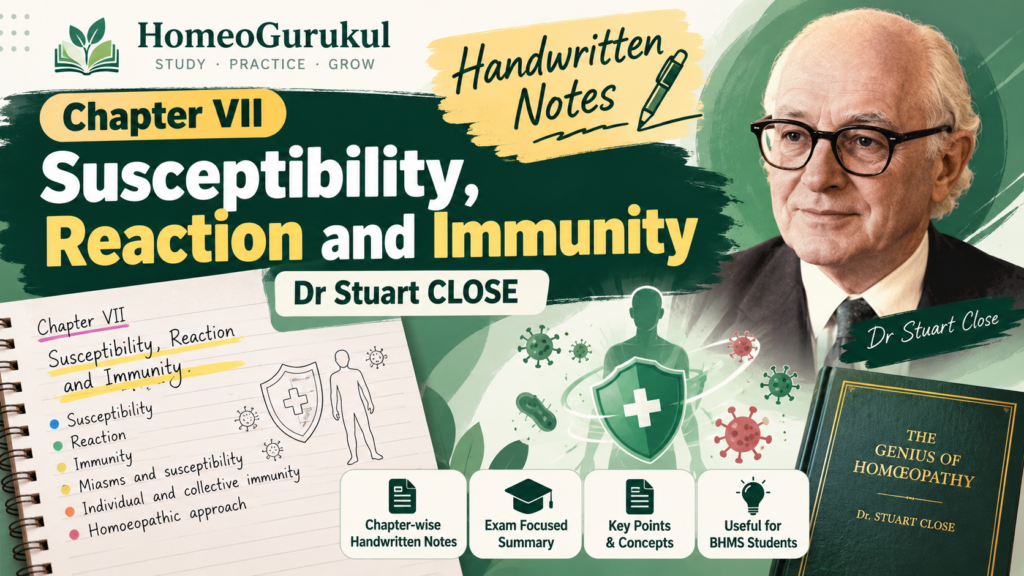
This chapter delves into the intriguing concept of “susceptibility,” which essentially represents how our
bodies respond to various situations. It’s like our body’s sensitivity meter, playing a pivotal role in both
falling ill and regaining health. Picture it as a sort of biological thermostat that influences our reactions
to external influences.
Imagine susceptibility as the body’s doorway through which external factors can enter and influence us.
This susceptibility isn’t just a passive state; it’s an active force that drives essential life processes such
as digestion, growth, repair, and even our ability to fend off infections.
Now, when it comes to understanding how medicines affect healthy individuals, researchers perform
“proving” tests. By administering a specific remedy, they observe the symptoms that arise. These
symptoms actually demonstrate how a person’s susceptible body reacts to the effects of the remedy.
Similarly, when an ailing individual is administered a thoughtfully chosen homoeopathic remedy and
their symptoms gradually ameliorate, it’s due to their body’s response to the healing influence of the
remedy.
The term “homoeopathic aggravation” points to a temporary intensification of symptoms that
occasionally occurs after giving a curative remedy. This is akin to a slight burst of symptoms as the
body reacts to the remedy’s action. This phenomenon underscores the body’s susceptibility to the
remedy and serves as a positive indicator of the body’s response to the treatment.
An analogy might help clarify this: consider a machine that has been dormant for a while. When you
start it up, you might hear creaking noises as the parts begin to move again. Similarly, the body might
exhibit discomfort as it begins to respond to the healing effects of the remedy. All of this aligns with the
principle that “Action and reaction are equal and opposite,” just like in Newtonian physics.
Now, here’s the fascinating part: our ability to modify susceptibility lies at the core of a physician’s
skillset. A skilled doctor can tailor a patient’s susceptibility to enhance their healing process. This
involves comprehending the patient’s needs, desires, and overall condition to augment their
responsiveness to treatment.
Visualize susceptibility as a spectrum. At one end, there’s the normal susceptibility that maintains a
healthy equilibrium, allowing the body to react appropriately to its surroundings. On the opposite end,
there’s either deficient or excessive susceptibility, where reactions can be either too weak or overly
intense. For example, some chronic ailments hit a plateau, impeding progress. This is when an “intercurrent
remedy” might come into play, stimulating the body’s response. This remedy is selected based on the
patient’s history and symptoms, reigniting the body’s natural reactivity.
Similarly, certain patients exhibit high sensitivity, reacting strongly to remedies. This heightened
susceptibility can pose challenges but can be managed by carefully matching remedies to symptoms.
Yet, modern medical practices sometimes disrupt our natural susceptibility. Think of the excessive use
of antiseptics. While they aim to eradicate harmful microbes, they also harm beneficial elements,
compromising our natural defenses. Similarly, aggressive stimulants might appear beneficial initially,
but they could deplete the body’s energy reserves, leading to more harm than good.
Homoeopathy values susceptibility holistically. It respects the body’s inherent ability to react suitably
to stimuli. Just as a healthy organism responds robustly to similar remedies, our bodies also react more
favorably to treatments aligned with our natural responsiveness.
Homoeopathy doesn’t just address symptoms; it values the body’s innate wisdom. Inflammation, fever,
and other natural reactions aren’t foes to be vanquished. They’re allies, aiding the body in reestablishing
balance.
Moreover, susceptibility’s scope extends to the broader realm of immunity. True immunity shouldn’t
compromise the body’s integrity. Inoculating with pathogenic products like animal sera or vaccines
might offer a false sense of immunity but at the cost of diminishing natural susceptibility. In contrast,
homoeopathic remedies, meticulously chosen and administered in minuscule doses, foster genuine
immunity by restoring health.
In essence, susceptibility is the linchpin of healing. It steers our body’s responses and governs our
reactions to treatments. By comprehending and honoring our inherent susceptibility, we can navigate
the intricate domain of health and illness more effectively, embracing a holistic approach to well-being.
Tags: